
A Complete Guide for Restaurants & Retailers (India 2025)
INTRODUCTION
The retail and hospitality industries in India have undergone a dramatic shift in the last decade. Once dominated by manual bookkeeping, handwritten bills, and basic cash registers, businesses today are embracing digital transformation faster than ever. Customers have become increasingly familiar with online shopping, UPI transactions, and instant payments. As expectations grow, companies must modernize their operations to deliver accuracy, speed, and convenience. At the heart of this transformation lies a powerful tool: the POS system.
A POS system, or Point-of-Sale system, has evolved from a simple billing machine to a sophisticated business management hub that integrates sales, inventory, payments, customer data, and analytics into a single platform. Whether you walk into a bustling supermarket, a cozy café, or a fast-moving quick service restaurant (QSR), it is highly likely that every order, every payment, and every stock update is being recorded through a POS system.
Yet, despite its ubiquity, many business owners still ask a fundamental question: What exactly is a POS system, and why is it so essential for my business?
To answer that, we must explore what a POS really does, how it functions, what components it contains, and how it changes the way businesses operate.
UNDERSTANDING WHAT A POS SYSTEM REALLY IS
A POS system is simply the place and technology through which a sale takes place. In earlier times, this may have been a basic cash register. Today, it has transformed into a blend of hardware and software that together enable a business to complete a sale, record it, manage inventory, accept different payment types, print receipts, generate GST-compliant invoices, and store customer data — all without involving complex manual processes.
In modern India, when you buy something at a store and watch the employee scan items, collect payment, and print a bill, you are witnessing a POS system in action. Behind that seemingly simple process lies an intelligent network that updates stock levels, records revenue, tracks taxes, and even sends data to the cloud for remote reporting.
The biggest strength of a POS system comes from its ability to bring together multiple business functions — billing, inventory, payment processing, reporting, accounting — and unify them into one smooth workflow. What once required multiple tools, books, and ledgers, now sits conveniently within a single screen.
THE EVOLUTION OF POS IN INDIA
POS systems did not appear overnight. Before computers became common, Indian businesses relied primarily on handwritten bills. This method worked for small operations, but as retail chains, supermarkets, and restaurant groups expanded, the limitations became obvious. Handwritten bills could not prevent pricing errors, track stock, or help business owners understand daily sales.
In the early 2000s, digital billing machines appeared. These were straightforward and helped generate printed receipts. However, they still lacked intelligence — they could not track sales, manage inventory, or provide reports. By 2010, computerized POS systems began to take over. These systems offered better functionality, allowing retailers and restaurant owners to maintain databases, search products, and record transactions in a more structured manner.
The real disruption came with the introduction of cloud-based POS systems. These systems moved data storage from local computers to the cloud, enabling business owners to access real-time information from any location. Growing chains like QSR restaurants, supermarkets, and cafés could now manage multiple outlets from one dashboard. They could centrally change prices, view total sales, and understand stock usage across multiple branches.
Today, POS has become an indispensable part of every retail and hospitality business. The evolution continues as artificial intelligence, automation, remote support, and real-time insights integrate deeper into POS platforms.
WHY MODERN BUSINESSES CAN’T FUNCTION WITHOUT POS
To appreciate why POS systems are indispensable today, imagine a busy evening at a quick-service restaurant. Customers stream in, some dining in, others placing takeaway orders. Online food delivery riders wait for pickup. The kitchen is working at full speed, costs need to be tracked, and ingredients must be monitored. Every second counts.
In such an environment, manual processes collapse. A POS system becomes the central nervous system — processing orders, routing them to the kitchen, updating sales and payments, handling online and offline orders, and syncing everything to the cloud. Without a POS system, business owners would struggle to maintain records, avoid mistakes, and deliver consistent service.
Even in retail stores, the importance of POS is undeniable. The need to manage multiple product categories, offer discounts, support loyalty programs, control stock, and record GST makes POS essential. Billing becomes faster and more accurate, queues move quickly, and customers enjoy a smoother checkout experience.
But beyond immediate operations, POS has a strategic value. It provides insights that help owners understand which products are selling, what times are busiest, which branches perform better, and how much inventory is being consumed. Decisions that once depended on guesswork are now backed by real data.
THE CORE COMPONENTS OF A POS SYSTEM
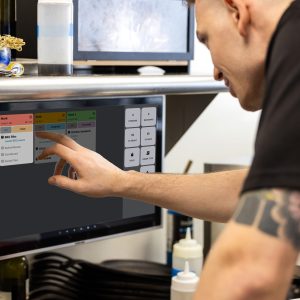
A modern POS system consists of several interconnected components. The first is the hardware — the physical devices used to perform transactions. These include the POS terminal or computer, thermal printer for bill printing, barcode scanner to identify products, and a cash drawer to store physical currency safely. In many businesses today, touch-screen terminals have replaced keyboard-only systems, making the experience faster and easier for staff.
The second major component is the software — the digital platform that controls billing, inventory, sales records, GST calculations, reporting, user access, and analytics. Some POS software lives locally on the device, while others operate through the cloud, enabling data to sync automatically across multiple outlets.
Accessories play an important role as well. Barcode labels, cables, and thermal paper rolls ensure smooth day-to-day operation. Finally, networking and cloud connectivity help transmit information securely between outlets and storage servers.
Together, these components allow a POS system to function like a unified business assistant.
HOW A POS SYSTEM WORKS — A SIMPLE NARRATIVE
Consider a small bakery in Bengaluru. A customer walks in and selects a pastry. The pastry is scanned using a barcode scanner. Instantly, the POS software retrieves its price, applies GST, and displays the final amount. The customer pays using UPI. The POS system completes the transaction, automatically prints a receipt, and updates both sales and inventory.
At the end of the day, the bakery owner can open the POS dashboard to see total sales, remaining stock, and insights into which products sold the most. If the bakery has multiple branches, cloud POS allows the owner to monitor all locations from a single screen, even from home.
What looks simple on the outside is powered by a perfectly synchronized platform that handles everything quietly in the background: inventory deduction, order history, payment logs, GST, and more.
TYPES OF POS SYSTEMS USED IN MODERN BUSINESSES
As digital adoption increases across Indian retail and hospitality, POS systems have diversified to suit different environments and budgets. The POS used in a local kirana shop will differ from the POS needed in a multi-branch restaurant group. Although the underlying purpose remains similar — billing, tracking, and reporting — the way POS systems operate varies significantly.
The most traditional model is the on-premise POS, where the software operates from a local computer and stores data in the same machine. These are usually older-generation setups, often still found in smaller shops. They are fast, reliable, and unaffected by temporary internet loss, but they require manual backups and lack remote monitoring. For business owners managing multiple branches or traveling frequently, this becomes limiting.
To solve these limitations, cloud-based POS systems emerged. Instead of saving data on a local hard disk, everything is stored securely in the cloud. This keeps all branches connected. A store owner can sit at home and still see what every shop sold that day, which items are running low, which counter is busiest, and how each outlet is performing. This real-time visibility gives owners a high level of control and convenience. Cloud POS also handles updates and backups automatically, ensuring the system stays secure and current without manual effort.
Some businesses choose hybrid systems — a blend of cloud and local functionality — so billing continues even without internet, while cloud sync resumes once connectivity is restored. This is particularly beneficial in regions with inconsistent connectivity, ensuring zero-downtime billing during rush hours.
For restaurants, especially QSRs, mobile and tablet POS systems are also becoming popular. Staff can take orders at tables, process payments, and send orders directly to the kitchen display. This makes order management seamless and reduces manual miscommunication.
Each business has different needs; hence selecting the correct POS type is essential. A small café may prefer a tablet-based POS, while a supermarket chain benefits more from hybrid cloud POS with extensive hardware integration.
HOW POS SUPPORTS RESTAURANTS & QSR OPERATIONS
The restaurant and QSR (quick-service restaurant) industry operates under intense pressure. Customers expect fast service, accurate orders, multiple payment choices, and consistent experience every single time. Without a structured workflow, chaos is inevitable.
A POS system streamlines this entire ecosystem. When an order is placed, the POS registers the item, applies relevant taxes, logs the inventory deduction, and routes the order to the appropriate kitchen station. If it’s a dine-in order, table numbers are managed easily. For takeaway and delivery, POS generates tokens and synchronizes with delivery partners.
In QSR chains such as KFC or Domino’s, kitchen display integration ensures that orders appear instantly on screens without needing paper tickets. This eliminates miscommunication and reduces delays. Managers can monitor how long each order takes, helping them refine operations.
Another major advantage is the management of online and offline orders from one platform. Today, restaurants receive orders from Zomato, Swiggy, Dunzo, and walk-ins. If managed manually, staff would constantly juggle systems. A unified POS solution merges all order streams, easing workload and ensuring accuracy.
The restaurant business relies heavily on ingredients. POS helps track stock usage precisely — cheese, bread, or sauce used in each order reduces automatically from inventory. This avoids wastage, theft, and manual counting. For central kitchens serving chains, POS data becomes essential to predict demand and schedule purchases.
Staff management is another overlooked benefit of POS. Owners can track who handled which orders, how much sales each person handled, and evaluate performance. Multi-level access maintains security; managers access financial data while counter staff view only billing interfaces.
POS becomes the invisible engine powering restaurant success — ensuring customers are served quickly, orders remain accurate, and management gets complete visibility into daily operations.
POS IN RETAIL STORES & SUPERMARKETS
Retail stores — from boutiques to supermarkets — deal with thousands of SKUs, offers, seasonal stock, returns, barcode labeling, and customer requests. Managing these complexities manually leads to consistent losses.
POS transforms the retail business into a streamlined, intelligent environment. Instead of manually keying product prices, barcode scanners instantly fetch rates and descriptions. This eliminates errors and keeps queues moving faster. Offers, discounts, loyalty points, and special rates can be applied automatically. Customers appreciate fast checkout and transparent pricing.
One of the most powerful features for retailers is inventory management. Supermarkets often face shrinkage due to theft, expiry, or miscounting. A POS system records every inward and outward movement of goods. Owners can see real-time stock, reorder levels, and waste percentage. Reports reveal fast-moving items, dead stock, and seasonal trends. Retailers can stock better and reduce losses significantly.
For multi-branch stores, POS solves one major challenge — pricing uniformity. Instead of updating rates branch-by-branch, cloud POS enables central control. Prices, offers, and catalogs can be updated simultaneously across all locations.
Retailers now have access to insights once limited only to large chains. With POS analytics, they can forecast demand, plan purchases, identify top customers, and adjust staffing for peak hours.
Modern retailers increasingly rely on omnichannel selling — in-store + WhatsApp + online marketplace + website. POS integrates all channels, ensuring inventory remains updated everywhere.
POS IN HOTELS & CAFÉS
Hotels and cafés have unique requirements. A café may require quick billing and kiosk-style express service, while a hotel requires more complex systems integrating room billing and F&B operations.
POS enables cafés to process orders quickly, handle dine-in and takeaway, connect to kitchen printers, run offers, and accept multiple payment modes. Loyalty programs help retain regular customers.
Hotels typically require room-wise billing, restaurant integration, and multi-counter operation. POS systems can ensure that a customer staying in a room can eat at the restaurant and add charges to their room with ease. This unified billing improves guest experience and reduces reconciliation work for staff.
POS also helps cafés understand their bestselling items, busiest hours, and profit margins. This helps refine menus and manage resources better.
THE REAL BENEFITS OF A POS SYSTEM
Beyond surface-level billing, POS delivers transformational advantages. It enhances operational efficiency, reduces dependency on staff knowledge, and introduces accuracy in every transaction. Business owners no longer have to worry about mismatched stock, missing invoices, or unauthorized discounts.
What makes POS more powerful is its ability to turn daily data into meaningful insights. Managers can identify which products contribute most to revenue, which stores or staff perform better, and which hours generate peak sales. This allows strategic decisions grounded in real numbers.
From a customer standpoint, POS ensures that they experience smooth service — minimal wait times, transparent billing, quick refunds, and modern payment flexibility. Fast service leads to happier customers and more revenue.
In many businesses, POS becomes the foundation upon which everything else operates. Staff training becomes easier since POS offers a structured interface. Business continuity improves because POS eliminates manual dependencies.
POS, in essence, is not just a billing system; it is the operational core that drives business intelligence, customer experience, and long-term growth.
THE RISE OF CLOUD-BASED POS IN INDIA
Over the last five years, India has witnessed a tremendous shift from traditional POS systems to cloud-based POS platforms. This shift has been driven by several forces — the widespread adoption of digital payments, growth of multi-outlet businesses, easy internet access, and the need for real-time business visibility.
While traditional POS systems store data locally on the device, cloud POS sends all data to secure online servers. This means that every transaction, every stock change, and every payment detail is backed up automatically and can be monitored from anywhere.
For a business owner running multiple outlets — say one in Bengaluru, another in Mysuru, and a third in Hyderabad — cloud POS is a blessing. Instead of relying on phone calls, WhatsApp messages, or employees’ verbal updates, the owner can simply open a dashboard on their phone and see everything instantly.
Cloud POS systems have become especially popular with QSR chains, supermarket franchises, boutique retail outlets, and cafés. Their ability to manage multiple branches, update menus centrally, and track combined revenue helps owners run operations smoothly without physically being present everywhere.
What truly sets cloud POS apart is its flexibility. Software updates happen automatically, new features roll out without downtime, and hardware requirements remain minimal. Even if the local machine stops functioning, data remains safe — reducing risk.
More importantly, cloud POS eliminates the fear of data loss. Traditional POS systems can crash if the hard drive fails or the machine is damaged. But cloud POS stores everything securely online, ensuring that business continuity remains intact.
As India embraces digital transformation rapidly, cloud POS is fast becoming the default choice for new businesses. Its reliability, mobility, and scalability position it as the future of billing and business automation in India.
THE IMPORTANCE OF CHOOSING THE RIGHT ACCESSORIES
While POS software forms the digital heart of operations, the physical experience of billing depends heavily on the hardware accessories connected to it. A POS setup is only as strong as the devices supporting it.
For instance, barcode scanners streamline retail operations by instantly fetching product details from the system. Without scanners, staff must manually type product names or codes, slowing down billing and increasing errors. In supermarkets and pharmacies, where thousands of SKUs exist, barcode scanners are indispensable.
Thermal printers are another essential accessory. They ensure receipts are printed quickly and neatly, helping customers verify their purchase details on the spot. High-quality printers reduce paper jams, unclear text issues, and downtime.
Cash drawers, though simple in function, must be durable and secure. They open automatically with each cash transaction recorded through the POS system, ensuring proper tracking of cash movement throughout the day.
Some setups also require handheld scanning tools, label printers, or kitchen printers. Kitchen printers are important for restaurants because they help staff communicate orders to the kitchen efficiently. When an order is placed at the counter, the printer instantly prints a ticket in the kitchen, ensuring no miscommunication.
Businesses often ignore the importance of cables, adapters, spares, and additional networking accessories until something fails. A well-prepared POS provider ensures that every accessory — no matter how small — is reliable, compatible, and well-maintained.
Together, these accessories transform POS from just a billing system into a complete operational engine that keeps the business running smoothly every day.
HOW TO CHOOSE THE RIGHT POS SYSTEM FOR YOUR BUSINESS
Every business is unique. A café serving 50 customers a day will have completely different requirements compared to a busy QSR chain or a multi-location supermarket. Choosing the right POS means evaluating needs carefully.
A small retail store, for example, needs fast billing, barcode scanning, and easy reporting. A fashion boutique will prioritize inventory management, style codes, and discount control. A restaurant, on the other hand, requires table management, KOT support, and kitchen integration.
Cloud access has become one of the most important factors to consider while selecting POS. Business owners want the freedom to manage operations without being physically present. With cloud POS, decisions like updating prices or changing menu items can be executed centrally for all outlets in seconds.
Businesses must also consider hardware compatibility, support availability, and integrations. A good POS system should work well with printers, scanners, online ordering platforms, payment systems, and accounting tools.
Customer support is perhaps the most crucial selection factor. Even the best POS will require assistance over its lifetime. Strong support ensures business continuity, while poor support leads to disruptions.
OneSphere Enterprises helps businesses select the right POS by understanding their workflow, infrastructure, and future expansion plans. With expert guidance, clients avoid unnecessary expenses and invest in solutions that serve them for years.
INSTALLATION AND IMPLEMENTATION — MAKING THE TRANSITION SMOOTH
Many businesses hesitate to adopt POS because they fear complications in transitioning from old systems. But with the right partner, installation is easy, fast, and stress-free.
A proper POS setup begins with understanding the business structure. The POS technician evaluates billing counters, network connectivity, accessory placement, and security needs. Hardware is installed, software is configured with product lists or menu items, taxes are mapped, roles are assigned, and printers are tested.
Staff training is an essential part of implementation. Even the most advanced POS becomes ineffective if employees don’t know how to use it. Training ensures that staff are confident in billing, canceling orders, processing refunds, and managing payments.
Once the system is live, the provider offers continued support for troubleshooting, changes, or additions. Businesses that upgrade to cloud POS find transitions especially smooth due to their remote accessibility and intuitive interface.
With OneSphere Enterprises, businesses benefit from complete assistance — from selection and installation to training and long-term support.
THE ROLE OF SUPPORT: WHY IT MATTERS MORE THAN ANYTHING
POS is a mission-critical system. If it stops working even for an hour, sales halt, queues build up, and customers leave frustrated. Lost sales damage revenue and business reputation.
This is why ongoing POS support — both remote and on-site — is crucial. Quick troubleshooting ensures minimal downtime. Software issues can often be solved remotely, while hardware faults may require in-person service.
A reliable provider like OneSphere Enterprises focuses not just on initial installation but lifetime assistance. Whether the issue is a printer not responding, a device not connecting, or a payment terminal failing, timely action helps prevent losses.
Good support is proactive. Preventive maintenance, device health monitoring, and timely consumable replacement keep operations stable. For businesses operating extended hours — cafés, restaurants, late-night stores — rapid response is non-negotiable.
Support is not a “nice to have” — it is a core requirement. The success of a POS system depends on how effectively it runs every day, and that depends heavily on strong service infrastructure.
HOW POS EMPOWERS MULTI-OUTLET BUSINESSES
As retail brands, cafés, and QSR chains continue to expand across cities, unified operations have become more challenging than ever. When all outlets are operating independently, tracking revenue, stock movement, and customer flow becomes complicated. Managers must visit stores physically or rely on delayed communication to understand performance.
With a centralized POS, multi-outlet management becomes effortless. Business owners can monitor every branch from a single dashboard — whether they’re in the office, at home, or traveling. They can see which outlet performs the best, which product categories are most popular in each location, and what time of day brings the most sales.
Cloud POS allows owners to update menus, product prices, taxes, or discounts across all stores instantly. The need to manually configure each outlet disappears. For QSR chains like KFC or Domino’s, this is essential because consistency is their identity. If a new combo meal is introduced, the pricing and details can be applied system-wide within seconds.
On the inventory side, multi-outlet POS helps track inward and outward movement more accurately. Stock transfers between outlets become easier to monitor. Slow-moving products in one outlet can be shifted to another where demand is higher. This ensures optimal product usage and reduced waste.
Even performance monitoring becomes more analytical. Managers can compare two branches side by side, analyze staff productivity, track order times, and adjust staffing levels based on footfall. These insights allow companies to make reliable decisions backed by real-time data instead of assumptions.
Simply put, multi-outlet POS systems turn expanding chains into organized, data-driven enterprises that can scale faster with control and clarity.
THE COST OF A POS SYSTEM IN INDIA — INVESTMENT & VALUE
For many business owners, one of the first questions regarding digital adoption is cost. They want to know how much a POS system will cost and whether it fits their budget. While costs vary based on several factors — hardware selection, software features, accessories, and the number of outlets — POS is perhaps one of the most valuable investments a business can make.
A typical POS setup includes a terminal, scanner, printer, cash drawer, and networking accessories. Hardware prices vary according to brand, durability, and performance capability. Some businesses use touch-screen terminals, while others opt for standard desktops.
Software licensing may be subscription-based, especially in cloud POS. This model reduces upfront costs and ensures continuous upgrades without large fees. Subscriptions often include regular updates, backups, and basic customer support.
Add-ons like kitchen printers, label printers, handheld scanners, or additional terminals will add to the cost. Networking equipment is required if the environment is large or distributed.
Although initial investment may appear higher compared to a simple calculator and manual ledger, the return on investment is significantly greater. POS systems reduce wastage, prevent pilferage, improve stock efficiency, and increase billing speed — directly affecting revenue.
Additionally, GST-ready reports simplify accounting. Staff dependency reduces as POS streamlines workflows. Owners discover insights that help shift business strategy, resulting in better profitability.
Therefore, rather than seeing a POS system as an expense, it should be viewed as a strategic investment — one that pays for itself within months through operational efficiency and better sales flow.
THE ROLE OF POS IN HOTELS & CAFÉS — CREATING A SEAMLESS EXPERIENCE
Hotels and cafés rely heavily on smooth customer interactions. Long delays or incorrect billing can ruin the guest experience. POS helps build a structured operation that supports every interaction — from dining to takeaway to room service.
In cafés, POS ensures fast billing and accurate order placement. The system displays items clearly, making menu navigation simple for staff. When offers or combos are active, the POS applies them automatically. Customers paying with UPI, credit cards, or wallets can complete transactions smoothly, accelerating the checkout line.
For hotels, integration between POS and room management systems ensures seamless posting of restaurant or café charges to a guest’s final bill. Guests can order food, beverages, or services and request room billing without worrying about carrying wallets everywhere.
Cafés and hotels also benefit from menu insights. By understanding which items are ordered frequently, management can adjust menus, run promotions, or streamline kitchen stocking. Trends like seasonal desserts, beverages, and special occasions can be tracked for smarter planning.
POS brings discipline and predictability to an otherwise fluid environment. It reinforces consistency — every item priced correctly, every payment recorded, every order delivered accurately. As a result, customer satisfaction rises, staff workload reduces, and business visibility increases.
HOW POS IMPROVES INVENTORY AND BILLING EFFICIENCY
One of the biggest challenges retail and restaurant businesses face is inventory mismanagement. Whether it’s fresh produce in restaurants or packaged goods in supermarkets, stock movement is constant and complex. Without a structured tracking system, businesses experience losses through spoilage, overstocking, pilferage, and expired products.
POS plays a critical role by linking every sale directly to inventory. When a product is billed, the system updates its stock count automatically. Real-time visibility helps owners know what items are running low, what should be reordered, and what is not selling as expected.
This eliminates the need for manual stock counts, which are both time-consuming and prone to errors. Automatic inventory tracking prevents stockouts during peak hours, which directly protects sales.
Billing also becomes more efficient with POS. Instead of manually entering prices, staff simply scan items. The system retrieves details instantly, applies GST, calculates the total, and issues the invoice. Faster checkout leads to shorter queues, happier customers, and more transactions per hour.
Billing accuracy supports trust — customers feel confident paying correct prices. Inventory accuracy supports profitability — owners reduce wastage and plan purchases well. Together, billing and inventory automation form the foundation of efficient modern commerce.
It is no exaggeration to say that a POS system protects a business from chaos. Without it, the business is constantly in reactive mode. With it, every decision becomes proactive, predictable, and aligned with growth.
HOW POS TRANSFORMS CUSTOMER EXPERIENCE
Customer experience has become the key differentiator among businesses. Whether someone is buying groceries or grabbing a quick meal, they expect fast, error-free billing and flexible payment options. POS helps meet these expectations consistently.
A robust POS system reduces billing time dramatically. Instead of searching for items and calculating totals manually, everything happens in a few seconds. UPI, cards, cash — customers can pay however they prefer. With accurate GST and item descriptions printed on receipts, the transaction feels transparent and reliable.
Customers also benefit from loyalty programs powered by POS. Their purchase history, preferences, and points can be tracked, enabling businesses to offer personalized promotions. This encourages repeat visits and builds long-term relationships.
In restaurants, POS enhances ordering accuracy. Orders routed digitally to the kitchen reduce confusion and eliminate mistakes. Wait times shrink, and customers receive their food exactly as requested. For takeaway and delivery, POS coordinates multiple channels, ensuring prompt service.
A well-implemented POS eventually becomes invisible — customers simply enjoy smooth experiences without noticing the technology behind it. That invisible reliability is what builds trust.
THE FUTURE OF POS SYSTEMS IN INDIA
India is on a remarkable digital journey. With UPI becoming one of the world’s most successful payment ecosystems and internet access reaching even rural markets, the retail and food service industries are set for transformation at an unprecedented scale. POS systems will play a central role in this evolution, becoming more intelligent, mobile, integrated, and service driven.
Over the next few years, POS will evolve far beyond billing. Already, many systems include dashboards to help business owners make data-driven decisions. The future will deepen this connection. Imagine a system that predicts what you will run out of next week, alerts you when an ingredient is nearing expiry, or automatically suggests menu pricing based on real-time food costs. This level of automation is not far away.
Artificial intelligence (AI) and machine learning (ML) are already being explored within modern POS solutions. These technologies will monitor sales trends, forecast demand, and help businesses reduce waste. For example, a restaurant might receive an automated alert advising it to reduce purchase quantities of certain vegetables during the next week due to expected lower demand. Similarly, retail stores might receive recommendations for rearranging product placement to improve sales.
Customer experience will be enhanced through personalized offers and targeted marketing. Since POS stores purchase history and behavior patterns, businesses will be able to send curated deals, loyalty points, and suggestions to customers directly. Instead of generic promotion, marketing will become predictive and intelligent.
Hardware will become more compact and mobile. Billing may happen tableside at restaurants or aisleside in supermarkets. Self-checkout kiosks, already popular in many global markets, will gradually appear in India too, especially in large supermarkets and hypermarkets.
Cloud POS will soon become the default choice. With continuous improvements in security, infrastructure, and network stability, storing business data in the cloud will be safer and simpler. Software updates will require no downtime. Multi-outlet management will deepen, allowing large brands to grow faster.
Hybrid environments will emerge too — where billing continues offline even when internet connectivity drops, and data sync resumes automatically after reconnection.
In short, POS is no longer merely an operational tool; it is becoming a strategic business asset.
WHY RELIABLE SUPPORT IS THE KEY TO SUCCESS
Businesses often compare POS devices based on brand, capacity, or features, but what truly defines long-term success is support. A POS system is central to daily business operations. When it stops working, the entire store or restaurant stops working. Machines can fail, printers can jam, software can crash — these scenarios are inevitable in real-world environments. What sets successful businesses apart is their ability to recover quickly from such disruptions.
Good support ensures that issues get resolved as fast as possible — ideally within minutes through remote access or over a call. When in-person assistance is required, having a responsive support team ensures minimal downtime. This directly protects revenue. A business that operates twelve or sixteen hours a day cannot afford hours of downtime simply because the billing system has crashed.
On-site and remote support from experienced technicians ensures that businesses do not suffer losses or unhappy customers. Even routine maintenance like checking cables, cleaning printers, replacing paper, updating software, or configuring networks can be managed smoothly with professional support.
OneSphere Enterprises emphasizes timely service. Because our expertise covers everything from hardware to networking, we provide a comprehensive support ecosystem that keeps businesses up and running. Whether it is a printer not responding, a faulty cable, a configuration issue, or system-level troubleshooting, our team resolves problems quickly to keep your operations uninterrupted.
Ultimately, support is not a luxury — it is a necessity. The efficiency of a POS system is directly tied to the quality of support behind it.
A POS SYSTEM AS THE CENTRAL NERVOUS SYSTEM OF A BUSINESS
When viewed from a broader perspective, a POS system is more than a billing tool. It is the central nervous system of retail and restaurant operations. Every transaction, every item sold, every payment accepted, every stock count updated — all these functions depend on POS. Without it, the business loses visibility, control, and efficiency.
Just as the human nervous system coordinates actions and responses, POS synchronizes the entire workflow. The cashier takes an order, the system captures the sale, inventory adjusts automatically, the kitchen receives accurate information, and the owner sees live reports. Every part of the business stays connected.
Because it regulates the most critical human-facing interactions — billing, orders, payments — POS holds a unique place in business operations. Running a modern store without POS is like flying an airplane without instruments. It may stay in the air for a while, but no one knows where it is headed.
With POS, retail and restaurant industries gain structure, precision, and insight. There is clarity in every process, and every decision becomes informed.
POS: INVESTMENT THAT PAYS FOR ITSELF
When business owners evaluate POS, they sometimes hesitate due to upfront costs. This hesitation is understandable but misplaced. A POS system protects revenue, prevents losses, reduces labour dependency, informs stock decisions, and enables better customer service. Any system that eliminates loss and improves efficiency begins paying for itself almost immediately.
Imagine a supermarket without POS. Cashiers manually enter prices, mistakes go unchecked, stock losses remain hidden, and end-of-day settlement becomes chaotic. A business may lose more money through mismanagement than the cost of implementing POS.
Similarly, restaurants without POS may face confusion during rush hours, leading to slow service, incorrect orders, customer frustration, and negative word-of-mouth. POS ensures the business runs systematically and reliably.
The measurable impact of POS includes faster billing, more transactions per hour, improved customer satisfaction, reduced waste, better stock planning, and deeper business insight. These benefits compound over time and directly contribute to higher profits.
Thus, POS is not a cost — it is a catalyst for growth.
THE STRATEGIC ROLE OF POS IN BUSINESS GROWTH
As competition increases across every market, businesses must operate with precision to stay profitable. POS systems provide the foundation for controlled growth. With clear visibility into sales patterns, customer behaviour, and product performance, business owners can experiment with strategies confidently.
A retail shop may identify that certain brands perform well in specific seasons, helping optimize stocking. A restaurant might personalize menus based on best-selling dishes. Chains can replicate successful outlets by learning from data.
Well-managed businesses scale faster, and POS is the foundational technology behind that structure. When every outlet, every department, and every staff member works within a unified system, the organization becomes capable of sustainable expansion.
CONCLUSION
The POS system has evolved from a simple billing tool to a high-powered operational platform that drives the retail and restaurant industries forward. Its ability to integrate billing, payments, inventory, customers, analytics, reporting, and multi-store management makes it indispensable in today’s fast-paced environment.
In India, where digital adoption is soaring and retail and food service markets are expanding rapidly, POS is no longer optional. It is a fundamental requirement — the foundation of modern commerce.
For restaurants, it ensures accurate order flow, fast billing, kitchen synchronization, delivery management, and intelligent purchasing. For retailers, it provides barcode-based billing, stock tracking, GST compliance, multi-store control, and sales analytics.
The rise of cloud POS has unlocked new levels of accessibility. Owners can manage business remotely, control multiple outlets, protect data securely, and scale confidently.
However, a POS system’s true value emerges only when supported by reliable, ongoing assistance. A condition OneSphere Enterprises deeply recognizes and fulfils.
As India moves toward an increasingly digital future, POS will continue growing as the backbone of retail and hospitality. Businesses that adopt it wisely will gain a huge advantage — efficiency, accuracy, customer satisfaction, and insight — the pillars required to win in competitive markets.
A modern world demands modern tools. And among them, nothing is more essential to a store or restaurant than its POS system — the very platform that transforms transactions into intelligence, and intelligence into growth.