
Introduction
In the rapidly evolving landscape of Indian retail and hospitality, technology has become much more than a supporting tool — it has become the backbone of everyday business. From supermarkets and boutique stores to cafés and fast-moving QSR chains, establishments increasingly depend on tech to streamline operations, serve customers faster, and remain competitive in crowded markets. At the center of this modernization is the POS (Point-of-Sale) system, the gateway through which every sale begins and ends.
However, not all POS systems are built alike. For years, Indian businesses relied on traditional POS systems, which ran offline, stored data locally, and worked through desktop-based software. They served a purpose when the flow of customer traffic was simpler and digital infrastructure less developed. But as markets expanded, payment preferences diversified, and businesses grew into multi-branch models, the weaknesses of traditional POS systems began to surface.
In response to these changing needs, cloud-based POS systems emerged. These modern systems shifted business data from local hardware to secure cloud servers, allowing businesses to monitor and manage operations anytime, anywhere. Today, cloud POS systems are redefining efficiency, cracking open new capabilities, and empowering even small stores to operate at the level of large corporate chains.
Yet many business owners still ask a common question —
Should I switch to a Cloud POS, or stick with my Traditional POS?
The answer is not the same for everyone; it depends on business goals, workflow, size, and priorities. For some, a traditional system might remain sufficient; for others, switching to cloud POS might unlock more growth than expected.
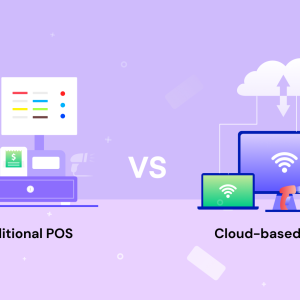
This blog explores the fundamental differences between traditional POS and cloud POS, helping you understand their strengths, limitations, and which one is right for your business.
How POS Became a Business Essential in India
Before exploring the difference between cloud and traditional systems, it is important to understand why POS matters in the first place.
Earlier, daily business operations in India ran almost entirely on manual workflows. A grocery shop owner mentally tallied prices and calculated totals on paper. A restaurant noted orders on slips. A boutique stored records in notebooks. While these methods worked in slower commercial environments, they struggled under urban expansion, GST-driven compliance, and growing customer expectations.
Today’s shoppers demand faster checkout, multiple payment choices, accurate billing, transparent taxes, and clear receipts. They expect convenient returns, instant refunds, and seamless service.
These rising demands pushed businesses toward POS adoption.
When a POS enters the system, several things happen:
▪ Billing becomes faster
▪ Price and tax accuracy improves
▪ Inventory updates automatically
▪ Customer data gets recorded
▪ Managers gain access to real-time sales
▪ Decisions become data-driven
POS brings structure, transparency, and reliability — qualities essential to scaling and survival in modern markets. As retail and restaurant formats expand to multiple outlets, POS becomes the unified spine that aligns all operations and reporting.
With this context, let’s now understand how the POS itself evolved from traditional models to cloud-driven powerhouse systems.
Traditional POS — The First Wave of Billing Automation
Traditional POS systems became widely popular in the early 2000s, when stores and restaurants recognized the benefits of digitizing billing. Instead of handwritten bills or basic calculators, businesses installed local software on desktop computers to manage prices and print receipts. These systems brought discipline — calculations became automatic, product catalogs became organized, and receipts printed accurately.
Traditional POS systems store data locally — within the computer or on a local server. They operate even without internet, making them reliable in unstable connectivity regions. They were ideal for single-store setups where reporting needs were simple and business owners stayed on-site.
However, as commerce evolved, traditional systems began struggling. When a business expanded into multiple outlets, each store operated independently. There was no easy way to centrally control prices or view sales. Data lived inside the four walls of each shop. Transferring information required pen drives, reports, or calls.
In a world that began moving faster each year, this structure eventually showed its limits.
Even so, traditional POS systems still exist across India, especially in Tier-2 and Tier-3 markets. They remain functional, but lack the elasticity and intelligence that modern businesses increasingly demand.
To understand whether traditional POS is enough or outdated, we must compare it with its successor — the Cloud POS.
The Rise of Cloud POS — Freedom Beyond the Counter
Cloud POS marks a significant leap forward in retail and restaurant technology. Instead of storing data in local machines, cloud POS stores all information on secure servers, accessible through the internet.
This simple shift brought massive advantages —
A business owner could now track sales from anywhere, whether they were home, traveling, or visiting another outlet.
Multiple stores could operate under the same umbrella.
Prices, menus, and product catalogs could be updated centrally.
Inventory could synchronize in real time.
Reports no longer needed extraction — they were live, visual, and instantly downloadable.
Cloud POS turned the POS system from a local billing tool into a business control center.
Its strength lies in connectivity. The POS is no longer chained to the counter; it is woven into the entire business ecosystem — integrating with online orders, payment platforms, accounting tools, CRM modules, and loyalty programs.
Especially in 2025, when retail and food service businesses are expanding rapidly, cloud POS has become the natural choice for long-term scalability.
How Traditional POS Fits Into Today’s Business Environment
Even though Cloud POS is gaining popularity, Traditional POS systems continue to serve many Indian businesses — especially those operating in stable, single–location environments. These businesses require fast billing, do not rely on remote management, and prefer predictable, one-time hardware/software investments.
A traditional POS is ideal for outlets where the business owner is physically present, manages stock manually, and does not need extensive analytics. Local data storage ensures functionality even without internet, making such systems dependable for regions where connectivity can be inconsistent.
But the lack of remote access becomes a drawback when the business wants to grow. Expansion introduces new information streams, complicating reporting, stock planning, control, and overall decision-making. If a business has multiple branches, each location often becomes an isolated unit — with no automatic synchronization. Owners must rely on screenshots, spreadsheets, or staff calls to collect daily numbers.
Thus, while traditional POS still offers value, especially for small setups, it cannot support the operational fluidity required by growing or multi-location brands.
The Engine of Growth — Cloud POS for Modern Brands
As India embraces mobility, cloud computing, online ordering, and digital payments, businesses need operational models that move at the same pace. Cloud POS enables this transformation by shifting business intelligence online.
Business owners gain visibility into daily revenue, category performance, taxation, top-selling products, and outlet-level analytics — even from home. Remote control becomes a reality.
The shift from reactive management to proactive control is what makes Cloud POS powerful. Owners can detect slow performance before it becomes a loss. They can compare outlet performance, tweak menus, modify pricing, or push promotions across all stores from a single dashboard.
This intelligence becomes the core of business growth. Instead of relying on gut feeling, owners make informed decisions based on real-time data.
More importantly, Cloud POS scales seamlessly. Whether a business is opening its second outlet or twentieth, the same system continues without disruption. Centralized data keeps the brand united while each outlet remains optimized.
Flexibility: The Turning Point
The most important differentiator between traditional and cloud POS is flexibility.
A traditional POS locks business data into a local machine. It works well only as long as the owner stays close to the counter. Any expansion forces manual coordination — calling store managers, exporting excel sheets, or visiting stores physically. This can easily become exhausting.
On the other hand, a Cloud POS operates anywhere.
Whether the owner is in Bengaluru, Pune, or Singapore — business visibility remains instant. Decisions such as price changes, stock transfers, menu updates, promotions, and access permissions can be controlled centrally, without needing physical access to any store.
This freedom allows businesses to scale faster and manage operations professionally, even with lean teams.
For this reason alone, most modern brands prefer Cloud POS — it enables them to operate with confidence and agility.
Inventory — From Manual Guesswork to Real Insights
Inventory management is one of the most challenging aspects of retail and F&B business. Getting it wrong leads to losses — either through wastage or missed sales.
In a Traditional POS, inventory updates happen only when staff follow the process correctly. It relies heavily on people. Manual errors, delayed entries, or outdated logs lead to two common problems:
▪ Overstocking — too much capital locked in
▪ Understocking — shortages during demand
The owner never sees true real-time numbers.
With Cloud POS, every sale auto-updates stock. Owners receive notifications when stock reaches reorder levels. Multi-store inventory allows stock redistribution based on demand. A bestselling product in one outlet can be replenished from another branch — balancing stock intelligently.
This automation prevents waste and increases opportunities.
Good inventory management alone can improve profitability significantly — and Cloud POS handles it so naturally that businesses feel the difference immediately.
Integration — POS Becomes the Core of the Business System
Earlier, billing was the only role of POS. Today, POS integrates with almost every business function.
Traditional systems often struggle with integrations.
Cloud POS thrives on them.
Online delivery platforms, UPI payments, card terminals, CRMs, loyalty engines, kitchen display systems, and accounting platforms — all plug into a Cloud POS system. Data flows automatically without duplication or delays.
For example, when a restaurant receives an order from Zomato, it flows straight into the POS. Billing happens seamlessly; inventory updates, the kitchen begins preparation, and reports reflect the sale instantly. The same order in a traditional environment requires manual entry — slow and error-prone.
The more integrated a business becomes, the less friction exists — and the smoother the customer journey becomes.
Dependence on Internet — A Balanced Perspective
Many business owners hesitate about Cloud POS because they fear internet disruption. It’s a valid concern. But modern Cloud POS systems are hybrid — they continue billing even when the internet temporarily drops, then sync data once connection resumes.
This hybrid model gives the best of both worlds:
▪ Stability of offline POS
▪ Power of cloud intelligence
Compared to traditional POS, which relies completely on local data (risking loss if the machine fails), Cloud POS protects business data through remote backup.
Thus, Cloud POS offers not only flexibility but safety.
Data Security — The Silent Difference
In today’s digital-first retail environment, data has become one of the most valuable business resources. Sales logs, customer profiles, inventory records, purchase histories, and employee performance metrics collectively define how a business runs. Protecting this information is no longer optional — it is essential.
Traditional POS systems store all data locally — inside a computer or on a small internal server. While this may seem secure on the surface, it creates a single point of failure. If the computer is damaged, corrupted, stolen, or infected with malware, the entire business record can vanish. Recovering such data is often difficult, if not impossible. Businesses that rely heavily on traditional POS know this risk well; many learn it the hard way.
Cloud POS systems, however, spread this risk. All data is stored on secure cloud servers that maintain multiple backups. Even if one device fails, business information remains safe and accessible from another terminal — or even a phone. Security layers like encryption, password protection, and authorized access keep sensitive information safe from unauthorized users.
Additionally, cloud platforms can update security protocols remotely. As threats evolve, the system evolves with them — providing businesses with modern defenses without interrupting operations. Businesses gain peace of mind knowing their data is continually monitored and protected.
In a world where data is power, Cloud POS ensures that power is never lost.
Scalability — The Growth Advantage
Every business dreams of expansion. Whether it’s opening a second outlet or scaling to multiple branches across cities, growth defines success. But growth demands systems that can expand along with the business.
Traditional POS systems struggle here. Scaling requires installing new software at every branch, recreating product catalogs, configuring price lists, setting up users, and manually coordinating reporting. It is slow, expensive, and chaotic. Every new outlet becomes an isolated island.
Cloud POS, however, is built for scale. New outlets can be added in minutes. Menus, product catalogs, tax slabs, discount structures, and user permissions can be cloned seamlessly and centrally applied. Business owners simply plug in terminals and begin operating.
Most importantly, reporting remains unified. Whether a business has two outlets or two hundred, all performance metrics flow into a single dashboard. This allows owners to compare branches, assign targets, analyze demand, and control operations efficiently — without travelling physically to each location.
This scalability alone has driven a massive shift toward Cloud POS among brands envisioning future growth.
Hardware Dependency — Fixed vs Flexible
Another distinguishing factor between traditional and cloud-based systems is hardware dependency.
Traditional POS usually depends on a fixed desktop-based environment. Billing must occur at a specific counter. If that computer experiences technical issues, billing stops entirely. The business becomes vulnerable to single-device failure.
Cloud POS, on the other hand, supports multiple device types. Billing can occur from a desktop, laptop, tablet, or even a mobile-based handheld terminal. Mobility becomes part of the workflow. If one device fails, another can take its place.
This flexibility not only supports continuous operations — it enhances customer experience. Restaurants can take orders table-side; supermarkets can bill customers from the racks; pop-up stalls can operate with handhelds; managers can monitor performance on personal devices.
Cloud POS decentralizes billing and democratizes access.
User Training & Ease of Use
Modern POS systems now prioritize user experience. New staff must be able to learn the system quickly — especially in industries with high employee turnover.
Traditional POS looks and feels like older desktop software — often rigid, technical, and less friendly. Training takes longer. Mistakes occur more frequently.
Cloud POS systems are built more like modern apps — intuitive, clean, and familiar. Billing screens simplify the product search. Buttons are clearer. Shortcuts are built thoughtfully. Cashiers learn faster. Managers train teams faster.
Better user experience becomes a competitive advantage — particularly in restaurants and retail formats that require quick staff replacement or seasonal hiring.
Businesses increasingly embrace Cloud POS for this reason alone — less training, fewer mistakes, faster onboarding.
Real-Time Decision Making — A New Business Culture
In today’s market, decisions must be quick. Waiting for end-of-day reports is no longer practical. Real-time data empowers businesses with agility.
Traditional POS offers limited visibility during the day. Owners and managers often call stores to ask for updates or wait for end-of-day summaries. By the time problems surface — lost sales, stockouts, slow counters — it’s too late.
Cloud POS eliminates this reactive culture. Every sale, every stock change, and every payment reflects instantly on central dashboards. Managers can detect issues immediately — low inventory, slow-moving items, outlet under-performance — and act before revenue is lost.
This shift from passive management to proactive leadership defines modern business success.
Cloud POS makes it possible.
Customer Experience — Where Cloud POS Wins Naturally
Business sustainability depends not just on how many customers arrive, but how many return. Customer experience is the heart of that equation, and POS systems play a quiet but defining role in shaping it.
Traditional POS systems handle basic billing efficiently. Customers receive printed bills, payment is processed, and the transaction concludes. However, the interaction ends there. There is no deeper engagement—no automated rewards, no personalized offers, no customer records, no post-sale connection.
Cloud POS, on the other hand, transforms the transactional experience into a relationship-building cycle.
Imagine a customer walking into a café and ordering their favorite beverage. The POS remembers their previous orders and suggests their preferences. The system automatically applies loyalty points and tracks their behavior over time. Promotions and discounts are customized to match their interests.
For customers, this feels familiar and warm.
For businesses, this creates retention and consistent revenue.
Cloud POS integrates with UPI apps, cards, wallets, loyalty programs, and CRMs. It enables faster checkouts, smoother refund processes, and accurate receipts. Customers feel respected, valued, and understood.
In retail environments, Cloud POS reduces waiting time significantly. Scanning is fast, data retrieval smooth, and payment effortless. Less time spent at the billing queue means happier shoppers — and more transactions per hour.
Businesses running on Cloud POS turn everyday customers into loyal customers. Traditional POS cannot do this on its own.
Offline Mode — Bridging Realities
India is a land of diversity — in language, culture, business style, and infrastructure. While metro cities enjoy continuous connectivity, semi-urban and rural belts still experience fluctuating internet speeds. Therefore, POS must adapt to this reality.
Traditional POS systems have an advantage here:
They work entirely offline because they store data locally.
Cloud POS, especially earlier versions, were heavily dependent on internet access. If the network failed, operations froze.
However, modern Cloud POS platforms have introduced hybrid offline mode, allowing businesses to continue billing even without active internet. Once the connection is restored, data automatically syncs with the cloud.
This innovation ensures that Cloud POS now matches traditional POS reliability while offering the massive benefits of real-time synchronization once online.
This hybrid evolution has helped businesses transition confidently toward cloud-powered solutions, knowing their operations won’t stop due to network issues.
The Cost Factor — Investment vs Value
Cost is often the deciding factor for many business owners when comparing Traditional and Cloud POS systems.
Traditional POS generally requires:
▪ Desktop terminal
▪ Software installation
▪ Local storage
▪ Occasional hardware upgrades
The cost is more upfront, one-time, and predictable.
However, there are hidden long-term expenses — maintenance, manual backups, hardware failures, and lack of remote support scale poorly.
Cloud POS usually operates on a subscription model.
Monthly or annual payments cover:
▪ Software
▪ Updates
▪ Backups
▪ Cloud storage
▪ Basic support
The upfront cost is lower. The system stays current with ongoing updates. New features arrive automatically. This aligns well with modern business models—pay as you grow.
For multi-outlet and growing businesses, Cloud POS proves much more cost-effective.
The initial cost may seem higher when considering recurring subscription fees, but when balanced against improved efficiency, centralized visibility, reduced downtime, and automated backups, the total ROI becomes substantially higher.
Businesses must analyze not just cost — but value.
Cloud POS delivers more value per rupee for scalable models.
Traditional POS may still hold value for small, single-outlet setups with minimal reporting needs.
Support & Service — A Critical Deciding Factor
No POS system, no matter how advanced, is immune to issues. Printers jam, scanners get disconnected, software requires updates, and networks misbehave. During such times, support determines whether a business recovers quickly or suffers losses.
Traditional POS support is often physical or hardware dependent.
Technicians must visit on-site to troubleshoot. This leads to delays and downtime. Businesses, especially restaurants, cannot afford stalled billing windows.
Cloud POS providers usually offer:
▪ Remote support
▪ Onsite support
▪ Automatic updates
▪ Preventive maintenance
With remote support, most problems are solved immediately over screen sharing or cloud intervention. This minimizes business interruption and ensures uninterrupted operations.
Companies like OneSphere Enterprises understand the urgency of issue resolution and provide responsive service, making Cloud POS a trustworthy operational backbone.
Support plays a defining role in determining which POS system to choose.
For high-traffic environments, Cloud POS support offers far greater assurance and continuity than traditional models.
Mobility — The Freedom to Operate Anywhere
In traditional setups, billing happens at one or two designated counters. Customers must come to the POS; the POS cannot go to them. This restricts service pace and creates bottlenecks.
Cloud POS breaks this boundary.
With handheld POS devices, billing can be taken to the aisle, table, or customer queue.
▪ Restaurants take orders tableside
▪ Malls bill customers on the floor
▪ Events and pop-ups operate portably
▪ Home-delivery units process instant payments
Mobility enables creativity.
It empowers businesses to sell anywhere — without being tied to a desk.
Cloud POS makes business models dynamic.
Traditional POS anchors businesses; cloud POS liberates them.
When Traditional POS Still Makes Sense
While Cloud POS has many advantages, traditional POS is not obsolete.
There are specific business environments where a traditional system still fits well.
A traditional POS may be suitable if:
▪ You run a single physical store
▪ You operate in an area with very unreliable internet
▪ You prefer no recurring subscription fees
▪ You do not need remote access or cloud reports
▪ You handle basic billing only
▪ You are comfortable managing inventory manually
Such businesses typically have straightforward operations — mainly billing, basic inventory, and receipt printing. If the store is small, owner-operated, and unlikely to expand in the near term, the simplicity of traditional POS can be enough.
However, it is important to remember that technology changes fast. A business that works fine with traditional POS today may face difficulties tomorrow when customer expectations increase or competitors adopt more efficient tools.
Traditional POS is functional —
but Cloud POS is future-ready.
Why Cloud POS Is Becoming the Default Choice
The modern business environment demands agility, intelligence, and reliability. Cloud POS naturally fits this expectation.
A cloud-based system gives business owners:
▪ Central control
▪ Real-time reporting
▪ Unified menu & pricing
▪ Multi-outlet management
▪ Digital payment integration
▪ Online order sync
▪ Automated backups
▪ Remote support
▪ Easy scaling
It enables a business to grow without constantly reinvesting in new software or workflows. The same platform can support five or fifty outlets with minimal additional effort.
Cloud POS encourages professional decision-making.
Instead of reacting, owners plan ahead.
Instead of guessing, they strategize with clarity.
This makes Cloud POS not just a tool —
but a business partner that helps shape the future.
The Human Side of POS — Empowering Teams
The benefits of Cloud POS are not limited to owners or customers — employees benefit too.
With smooth workflows, clean interfaces, faster billing, and automated entries, staff can focus on serving customers rather than wrestling with the system. Training becomes easier, productivity rises, and mistakes reduce significantly.
Employees feel more confident when they have reliable tools.
This confidence reflects in the quality of customer service.
Managers too can track performance metrics —
Who handled how many bills, during which hours, with what accuracy —
Data can highlight high performers and guide training.
Teams grow stronger as the system supports them.
The Bigger Picture — POS as the Digital Backbone
When viewed from a wide lens, the comparison between Cloud POS and Traditional POS is not just about software.
It reflects the cultural shift in business operations.
Traditional POS belongs to a world where business was local, slow, and simple.
Cloud POS belongs to a world where business is fast, digital, and interconnected.
A POS system is not just a billing tool —
It is the digital backbone that connects every part of a business:
Billing → Inventory → Customers → Insights → Decisions → Growth
The question is not just “Which POS is cheaper?”
But rather:
“Which POS will enable me to grow confidently?”
Final Decision — Which Should You Choose?
Choosing between Traditional and Cloud POS depends on your business journey.
✅ Choose Traditional POS if:
✓ You run a single outlet
✓ You don’t require remote access
✓ You have stable, predictable operations
✓ You prefer a simple one-time setup
✓ You are comfortable without modern analytics
✅ Choose Cloud POS if:
✓ You want real-time monitoring
✓ You plan to grow into multiple outlets
✓ You need centralized control
✓ You depend on online ordering
✓ You want mobile POS flexibility
✓ You value analytics and insights
✓ You seek reliable remote support
Most modern businesses benefit dramatically from moving to Cloud POS.
For small setups, traditional POS might still suffice —
but as soon as business ambitions grow, Cloud POS becomes the undeniable winner.
Conclusion — The Smarter Future Belongs to Cloud POS
Technology does not stand still, and neither do customers.
India’s retail and restaurant landscape is evolving rapidly, powered by digital payments, cloud computing, mobile commerce, and data intelligence.
In this journey, Cloud POS is emerging as a must-have system —
not just for big brands, but for small and mid-sized businesses that want to operate efficiently, impress customers, and scale without stress.
Traditional POS served its time —
but Cloud POS defines the future.
It provides the freedom to manage business anywhere,
the confidence to make decisions backed by data,
and the power to deliver exceptional customer experiences.
Businesses that adopt Cloud POS are better positioned to thrive —
not just today, but for years to come.
Whether you run a QSR, café, supermarket, garment store, or pharmacy,
the Cloud POS is your gateway to modern, intelligent, customer-centered commerce.
As India continues moving boldly toward digital transformation,
the businesses that embrace this change with smart POS solutions
will lead the market, earn customer trust, and unlock sustainable success.